26 October 2005

Iran’s Ahmadinejad says Israel will be wiped off the earth


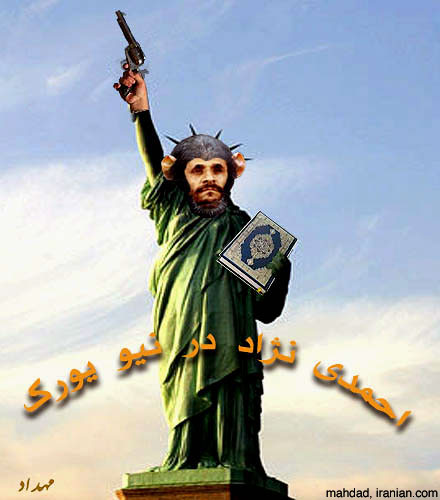
Satirical comic, but serious words from Iran’s hard-line President Mahmoud Ahmadinejad
(Art: Iranian.com)

Iran’s Ahmadinejad says Israel will be wiped off the earth

Wed. 26 Oct 2005
Iran Focus

Tehran, Iran, Oct. 26 – Iran’s hard-line President Mahmoud Ahmadinejad charted his government’s unyielding course vis-à-vis the state of Israel while totally rejecting the Middle East roadmap to peace as a diversion from the crusader wars between the Islamic world and World Arrogance, or the United States.

Speaking at a seminar entitled “World without Zionism”, Ahmadinejad said that Israel was the product of an ideological war between the “Arrogant World Order” and the “Islamic rule”, adding that the Jewish state had to be wiped off the face of the earth.

“The creation of the occupying regime in Qods [Israel] is a strong action by the ruling arrogant (imperialist) world order against the world of Islam. There continues a historic war between the World Arrogance and the Islamic world, the roots of which go back hundreds of years ago”, Ahmadinejad said.“Over the past 100 years, the last bastions of the Islamic world have collapsed. The World Arrogance turned the Zionist regime occupying Jerusalem into a staging-ground to dominate the Islamic world”.

“This occupying country is in reality the staging-ground of the World Arrogance in the heart of the Islamic world. They have created a base, from where they can expand their rule over the entire Islamic world; it has no other purpose other than this”.

Inciting that the battle for Qods, or Jerusalem, went back to the crusader wars, the outcome of which would ultimately determine the new world order, Ahmadinejad said, “The war that is presently going on in Palestine is the frontline of the war of destiny between the Islamic world and the World Arrogance, which will determine the outcome of hundreds of years [of war] in Palestine.”

“Many sow the seeds of defeat and despair in this intense war between the Islamic world and the blasphemous front and hope to empty the hearts of the world of Islam”, Ahmadinejad, who was previously a top commander of the Islamic Revolutionary Guards Corps (IRGC), said, adding that such people wonder whether there would come a day when one would see a world without the United States and “Zionism.”

“This slogan and goal is one which is attainable and could definitely be realised”. “Our dear Imam [Ruhollah Khomeini] ordered that the occupying regime in Jerusalem be wiped off the face of the earth. This was a very wise statement. The issue of Palestine is not one which we could compromise on. … This would mean the defeat of the Islamic world”, he insisted.

“In his crusade against the World Arrogance, our dear Imam targeted the central and command base of the enemy, namely the occupying regime in Jerusalem. I have no doubt that the new wave [of attacks] which has started in dear Palestine and which we witness today all over the Islamic world will soon wipe this scourge of shame from the Islamic world. This is doable”.

The hard-line President said that for the past 50 years the United States had been trying to give legitimacy to Israel. He criticised “a country on the frontlines of the war”, or Egypt, for having recognised the Jewish state, while warning of similar “threats” elsewhere in the Islamic world.

“With the excuse of having cleared the Gaza Strip to show their good will, they want a group of Muslim nations to recognise this corrupt regime, and I am very hopeful and call on God that the Palestinian people and the dear Palestinian groups will be cautious of such sedition”.

“The issue in Palestine is by no means finished. The Palestinian issue will only be resolved when all of Palestine comes under stringent Palestinian rule”, Ahmadinejad vowed.

“I am hopeful that just as the Palestinian nation continued its struggle for the past ten years, they will continue to keep their awareness and vigilance. The current period is going to be short-lived. If we put it behind us successfully, god willing, it will pave the way for the destruction and the downfall of the Zionist regime”.

He warned the heads of other Islamic states to beware of the sedition by Israel and not to go along with the old world order otherwise they would be “burnt in the fire of the Islamic Ummah (Nation) and will bear an eternal stigma on their foreheads.”

In a separate development, five Israelis were killed and at least 30 injured in a suspected suicide bombing in the Israeli costal city of Hadera on Wednesday.

Urbane Analysis: But let's look at the positive - the man said "(t)here continues a historic war between the World Arrogance and the Islamic world, the roots of which go back hundreds of years ago” - so clearly he agrees that George W. Bush did not "start" the war on terror by arresting Saddam Hussein and freeing the people of Iraq from Islamo-facism. Common ground, its a starting point for dialogue...

Sorry about the cynical-satirical mood today.

Sincerely,

The Urbane R of the good 'ole red, white and blue World Arrogance

24 October 2005

Ugandans: Fed Up With Museveni's Corruption

"We make a mistake by assuming that corruption is a management issue, yet it is a political issue. Before you talk about everything, it is the politicians that must first develop zero tolerance for corruption"
Zie Gariyo - Uganda Debt Network


Photo by Wandera w’Ouma

Is Uganda fighting a fruitless battle against corruption?

ELIAS BIRYABAREMA
The Monitor (Kampala) & All Africa.com

The latest corruption perception index (CPI) report, which showed a troubling decline in Uganda's performance, appears only to confirm the view that the country's leadership lacks the will to curb the evil, according to analysts.

In interviews conducted by Business & Finance last week, several people cited a contradiction in Uganda's poor performance that is coinciding with intense efforts by the government to fight the graft.

In its Corruption Perceptions Index (CPI) 2005 report, Transparency International (TI) gave Uganda a score of 2.5 out of 10, with the lowest score indicating the most widespread corruption.

In world rankings, out of the 159 countries surveyed this year, Uganda emerged 35th most corrupt. It was a distressing decline from the 2.6 score of last year, sparking off soul searching by analysts who are wondering why the country should decline at a time when government is giving ever more confident assurances that it is combating the graft.

In regional rankings (Africa), it (Uganda) is 17th most corrupt out of 44 countries surveyed while in East Africa, it follows Kenya as the most corrupt with Tanzania emerging as the cleanest.

The National Programme Manager for Transparency International Uganda Chapter, Mr Charles Mubbale, contended that while it is true that the government had stepped up efforts to combat corruption, real change in peoples' perception, which is the basis of the TI's score and rankings of countries, would not be immediate. Instead, he said, the impact would occur gradually, perhaps become reflected in CPI reports of five or so years to come.

"In countries where government and others have made substantial efforts to combat corruption with demonstrable results and where there is no improvement in a CPI score, there is a possibility that these efforts, however successful, have not been adequately communicated," he said.

Mr Zie Gariyo, who heads the Uganda Debt Network, an organisation that championed the fight against graft for nearly a decade, scoffed at the suggestion of better institutions and commitment by government to fight corruption.

"We make a mistake by assuming that corruption is a management issue, yet it is a political issue. Before you talk about everything, it is the politicians that must first develop zero tolerance for corruption," he said. If the top leadership in government still believes in use of patronage, largesse and rent seeking to mobilize political support, he argued, then even a thousand laws and institutions will never have any meaningful impact.

Last week, the on-going inquiry into the misuse of funds meant for fighting Malaria, Tuberculosis and reversing the HIV/Aids pandemic, revealed that top government officials irregularly received money meant for health care.

According to Gariyo, it would be a farce to start talking of laws and institutions when the people who establish them and are supposed to ensure that they work do not feel the need to act transparently.

"We certainly expect President Yoweri Museveni to punish [Jim] Muhwezi, but its highly uncertain he will," he said. Muhwezi has been accussed for mismanaging funds meant for fighting Malaria, Tuberculosis and reversing the HIV/Aids pandemic.

Caught red handed? Ugandan Major General Jim Muhwezi visits the Elizabeth Glaser Pediatric AIDS Foundation site in Uganda
photo: Elizabeth Glaser Pediatric AIDS Foundation

Uganda's poor performance is a somewhat demonstration of the public's lack of confidence is government's anti-corruptions efforts.

Although President Museveni for instance, has made a public show of his readiness to deal with havens of corruption - the Uganda Revenue Authority, Police and Judiciary, no one has so far been prosecuted.

Last year, BoU paid nearly $20 million to city tycoon Basajja Balaba's creditors in a move that was largely perceived to be politically engineered. In a briefing paper about Uganda's performance on corruption, TI Uganda showed that the greatest impact of corruption is on the poor because it mainly disrupts mechanisms of delivering essential services to them.

Regionally, Uganda's dismal performance and the potential damage comes at a particularly sensitive time: the government is currently spending billions of shillings to burnish the country's image abroad and attract foreign investors.

Corruption spikes the costs of starting and running a business and many an investor would shun a country where he knows that competition doesn't take place on a level ground. The report thus is a stark reminder to policy makers that the ongoing campaign blitz to sell the country's potential to prospective investors should perhaps go lockstep with efforts to address the real and enormous challenge of graft perceived by Ugandans.

20 October 2005

Another Attack in New York

With the enormous shot-in-the-arm to Ann Coulter's career brought on by the premiere of George Clooney's 'Good Night and Good Luck' I cannot but recall some bigtime 'Liberal McCarthyism' going on last Spring when we heard from Stanley Kurtz at National Review Online about the challenge to accreditation for a school called The King's College located in the Empire State Building in New York City:


King’s College has been accredited by the New York State Board of Regents for over 40 years, and all was on track for yet another renewal. After the college was scrutinized by the New York State Board of Education and an external site visit team, the Regents’ own Advisory Council recommended a five-year extension of King’s accreditation. So the stage was set for a fascinating experiment in higher education — an ultimate encounter of red and blue America.

That was until King’s College caught the attention of John Brademas, a quintessentially liberal politician, and one of the newest members of the State Board of Regents. Brademas had been a liberal Democratic congressman from Indiana, but was defeated in 1980 (according to this study with major opposition from the Moral Majority). After his defeat, Brademas went on to serve as president of New York University for a decade — a period during which NYU consolidated its reputation as a liberal bastion.


Pretty alarming stuff, a real 'Culture Wars' skirmish if there ever was one. But as Kurtz points out, that's not all...
John Brademas


And the public is watching. Recent political and social developments have encouraged traditional Christians to believe they may not have to hide themselves away in order to survive. The decision of King’s College to move to New York City in order to prepare students for public leadership reflects that change. Fearing this (and forgetting America’s long history of religious education) some residents of blue America are busy spinning out fantasies of an imminent theocracy. The result, I fear, is exactly the sort of discrimination liberals claim to oppose — yet now themselves inflict on the traditionally religious. Well, the jig is up. Conservatives of all stripes are tired of being shut out of the academy and America’s other cultural centers. We want in — and that includes New York City, whether the John Brademases of the world like it or not.


You go, Stanley!

So, what about King's College anyway? Here's a snapshot from World Magazine:

The King's College, a conservative, Christian institution that holds its classes in the Empire State Building, may be shut down. Despite a solid record of achievement and positive outside assessment, a member of the New York state Board of Regents is trying to do just that. Founded in 1955 in Briarcliff Manor, N.Y., the college closed 10 years ago but was purchased in 1999 by Campus Crusade, which moved it to New York City. Its student body is small—260 students—but average SAT scores are 1,140 and high-school GPA is 3.5. The school has programs through Oxford University and majors in politics, philosophy, economics, and business. (The New York program of the World Journalism Institute, a WORLD affiliate, is held at The King's College.) The school passed its accreditation review, which allows students to receive federally subsidized financial aid, with flying colors, and the state Education Department recommended a five-year extension. But when the recommendation went to the state Board of Regents, a step that is usually a formality, one member objected.

Brademas on the stump


So what do elite Brahmins of the Liberal Salon like John Brademas think about Evangelical Christians, really? Insight comes from this New York City seminar called "Examining the Real Agenda of the Religious Far Right" that included bestselling author Karen Armstrong on "Fundamentalism: The Fear and the Rage" among other presenters. How do they describe it? Let them tell you:

Most Americans outside the Bible Belt have little idea of the beliefs held by millions of fundamentalist churchgoers. We have an almost total lack of awareness of the rise of Dominionism and Christian Reconstructionism, forms of theology that advocate a biblical vision of God’s kingdom on earth. Some fundamentalists also foresee events such as The Rapture, the Times of Tribulation, Armageddon, and the Second Coming of Christ as we enter The End Days.

This conference will give rigorous attention to the worldview of Dominionism, its influence in contemporary political culture and its agenda for America. While not all Christian fundamentalists are Dominionists, Dominionism’s influence is powerful and growing. Its adherents play a significant role in secretive organizations such as The Council on National Policy, which exerts a strong influence on the strategy of the religious right.

The 2004 election tells us that socially conscious citizens need to awaken to the ambitions of this influential religious movement. What do fundamentalist theologies advocate regarding theocracy, abortion and homosexuality? What is the nature of the world order under God’s law that they anticipate? How do many fundamentalists interpret the role of Israel? How does this affect U.S. policy? Why are so many fundamentalists opposed to environmentalism and the UN? Why are millions in America drawn to this form of belief, and how can we come to understand them?


Wow, once these liberals understand this stuff, my bet is we'll have more neo-cons coming along! In order to understand the depths of left wing paranoia, check out the discussion of "dominionism" here and here - this is what extreme liberals mean when dropping the term "theocracy" (defined here and here) so incessantly. They rail away (notice how they said "dominionism" four times in two paragraphs above) in exactly the same way fringe elements on the right are fundamentalist. Basically the fundamentalist fringes are in competition here. And reasonable people will see that - when taking a truly objective look at this debate. It goes way beyond the bounds of debate, however, when elites use their power to shut down the debate as Brademas has against Kings.

As for the intra-faith dialogue organization Council on National Policy, which is no more (or less) secretive than left-wing Christian organizations like Bread for the World and the Fellowship of Reconciliation, but it certainly must be "threatening" - what with its membership of Roman Catholics, Evangelical Christians, and (the horror) mainstream Protestants like Episcopalians and Presbyterians! Especially since for "Chicken Little" left wing demagogues, if Republicans aren't giving away the play book and then (finally!) start to lock the backroom door like liberal think tanks and labor unions do when they get together with academics and Hollywood elites, well, then so-called theocracy is afoot. And make no mistake: the CNP is absolutely wide open "big tent" kumbaya-singing scout camp in comparison to left wing organizations like Greenpeace and everything to do with the Boys Club finances of Air America. Hey, everyone's not going to be like George Soros! By the way, notice that every time a liberal talking head starts spouting about "theocracy" - the host never asks the obvious follow up like "either provide a realistic theory of how that word definition applies to America or 'can it' already!" You know, WWBOD? (what would Bill O'Reilly do?)


Photo: World Magazine


So what happened with John Brademas' all-out attack to snuff out King's College? He almost succeeded. The Christian Post picks up the story:

The March meeting ended in confusion with the Board opting to limit the school's accreditation to one year, which some call "strangulation" as opposed to instantaneous death. At this point, the school sought help through prayers, its national network of supporters, and also the media, and gained the attention of the State, which required the school to undergo an additional review rather than rebuking the Board of Regents. After the second site visit, during which professionals submitted a flawless report, the Board of Regents extended the college’s accreditation to five years on July 21.

"I know we created a lot of discomfort for politicians who though they could squash an evangelical college in NYC, and nobody would care. They found out that that isn't the case," said Provost Dr. Peter Woods.

About Brademas, Woods said, "He tried to destroy the college but he failed. He was up against a stronger and higher power than he realized."

So the little school at the Empire State Building succeeded against a King Kong-style attack by the elite liberal uber bureaucrats of Gotham. But the question remains, why would liberals go to such great effort to kill a school? Why not just leave them alone? These are questions that need open and frank discussion.


Maybe it is the continuing failures of the left at the ballot box, but these folks are bent on a 'Culture War', as the City University seminar betrays:
Join us for this important conference as America grapples with the growing influence of fundamentalist religion and its political goals. Clearly, something within this movement addresses the need for spirituality and community in an America submerged under materialism and consumerism. The time has arrived to take the ambitions and prophecies of extreme Christian fundamentalism seriously, and to examine the compatibility of these beliefs with democracy as we currently know it.

The ongoing lionization of Edward R. Murrow in relation to his engagement on the issues with Republican Senator Joe McCarthy - is all about prior restraint on free speech and free expression. It was a challenge to democracy during McCarthy's time - on the public stage in exactly the same way that conservatives are today "outed" and marginalized in the mainstream media, civil service, and at most universities. Yeah, we got McCarthyism today - in faculty hirings on 90% of the college campuses in America. Make no mistake: liberals questioning Christian faith regarding the "compatability of these beliefs with democracy as we currently know it" - smacks of exactly the kind of zealotry and fundamentalism which liberals try to pin on their chosen adversaries. And all it takes is one champion hothead (are you listening Democratic National Committee Chairman Howard Dean?) to morph into the neo-McCarthyism we have right now. No wonder FNC (Fox News Channel) is such an annoyance to liberals - it is the only major television media outlet they haven't taken down. The difference is today we have many neo-McCarthy's: Howard Dean, Bill Maher, Al Franken, Nancy Pelosi, Barney Frank, Jim McDermott, Richard Durbin, Patrick Leahy, Carl Levin and...

If you ask me, it is precisely because of this tension that The King's College is doing important work, in an important place, at a very important time. And exactly because important non profits like the Gates Foundation and World Vision are in my home city, Seattle Pacific University has no less a challenge. At SPU the theme is "Engaging the Culture, Changing the World" - and Christian universities, once engaged on that quest (none my dare call it Crusade) will do just that.

All of you mystified secular humanist liberals wanting some insight regarding post-modern Christ-followers, explore the world of Pastor Erwin Raphael McManus. Its a land of barbarian love: prepare to be transformed by The Guy he follows...

15 October 2005

Worldwide Focus on the Children of Gulu and Northern Uganda

GuluWalk: on foot for the children of Uganda
Forty-thousand children in Uganda walk 11 km to safety every night in order to escape the rebel army, and on Oct. 22, thousands of people around the globe will walk the same in a world-wide movement for peace.

By Chloë Schama
HappyNews Citizen Journalist


Every night in northern Uganda, tens of thousands of children from rural villages flee their homes for distant urban centers, driven by fear of abduction and forced conscription by rebels who, for the past 19 years, have waged a bloody civil war against the Ugandan government.
After sleeping in makeshift shelters, these "night commuters," as the children are called, walk home, only to repeat the journey the next evening. Moved by the children's plight, uNight, a group of New York activists, has organized an event that they hope will draw attention to this often overlooked conflict.

On October 22, demonstrators will walk from the outskirts of 40 cites, scattered across the United States and the world, into the various city centers. Organizers hope that this global demonstration will focus attention on the issue and increase the level of U.S. and UN intervention in the region.
The Lord's Resistance Army (LRA), a rebel group that seeks to overthrow Ugandan President Yoweri Museveni, is largely responsible for the violence that ravages the northern part of the country.
Harrowing testimonies of rape, abuse and child conscription have emerged from the region over the years, yet Museveni's government has failed to provide adequate protection for the area's inhabitants. Up to 1.4 million people have been displaced from their homes, and over 20,000 children have been kidnapped by the LRA over the past 10 years, according to the United Nations Office for the Coordination of Humanitarian Affairs. The UN estimates that over 40,000 children make the nightly commute to safety.
GuluWalk, the name of the event, takes its name from the Ugandan city of Gulu, located approximately 150 miles north of the capital, Kampala, where over 20,000 children from neighboring towns and villages spend the night. The event is the second stage of a larger campaign, begun this past summer by two Canadians, Adrian Bradbury and Kieran Hayward, who carried out a month-long simulation of the children's commute by walking from the outskirts of Toronto into the city center.
The New York group is a mix of idealistic 20-somethings and older professionals. Ochoro Otunnu, one of GuluWalk New York's central organizers, was born in Gulu and has worked for Oxfam America and the Africa AIDS Initiative. He lived in Uganda until he was 11, when his family fled the country to escape the regime of the Ugandan dictator, Idi Amin.
After living as a refugee in Kenya for three years, Otunnu returned briefly to Uganda after Amin was overthrown, but he soon left to study in the United States where he now lives. He sees GuluWalk as "a commitment to speak out for the people of northern Uganda," an attempt to restore to the children of northern Uganda the innocent pleasures he enjoyed as a child.
Daniella Boston, a recent college graduate and another central organizer, wrote her undergraduate senior thesis on Ugandan politics. Though she traveled widely through Uganda during the course of her research, she was frustrated to find that, as she put it, a "huge chunk of the country" was inaccessible. Daniella hopes that GuluWalk New York will unveil at least part of the atrocities committed in the region.
"The first step towards resolution of this humanitarian catastrophe is to put northern Uganda back on the map," she said.
Other participants have comparably diverse backgrounds. Jonathan Gross, a Masters candidate at the School of Public Health at Columbia University who once lived in Uganda, feels that a moral imperative drew him to the campaign.
"I had no ethical choice but to be involved in the campaign," he admitted. "These are children."
Anthony Bailey, a Jamaican-born New York entertainment lawyer, said he is tired of the feeling of helplessness and impotence that overcomes him when he sees starving and maltreated women. The project offers him the opportunity to actually do something that may have an impact.
For more information about GuluWalk, please visit their Web site. To learn more about the campaign in New York or to get involved, please contact Daniella Boston at daniella@unight.org or visit Unight.


This story was produced by Happynews Citizen Journalist, Chloë Schama. Schama lives in Washington, DC and works for The New Republic magazine.
For more information on contributing to Happynews, click here.


Urbane Encouragement: This is a great cause, and could become a regular awareness-raising event in urban centers around the world. For the locations of the October 22 event, click here. For information on what's happening about this in Seattle, click here.

Learn more about the documentary Stolen Children,Hidden War and get active on behalf of children caught up in the worst humanitarian crisis on the planet - happening this night, and every night - in Uganda.

And thanks to Happy News for covering this story - it is a situation crying out for awareness - and coverage in the mainstream media. It is a cause that activists on both the Left and Right can unite in their concern to bring a cry of outrage against the regime of Ugandan President Yoweri Museveni for neglecting.

14 October 2005

The Discovery Institute and the 'Open Architecture' of Democracy

Discovery Institute: passionate about hearing many voices through blogging.

After attending a Discovery Institute forum last night on economics and democracy featuring Ghana's Franklin Cudjoe of the Imani Centre for Humane Education, I just have to say, the DI is impressive - with President Bruce Chapman himself conducting the event for over twenty five people like a gathering of friends - and setting the tone for deep and insightful questions following Cudjoe's insider report on economics affecting west Africa.

It was great to meet DI's rising star Yuri Mamchur, and talk about the work he is doing with Russia Blog. And it was just a treat to be able to meet DI Director Robert Wiley III and talk about my favorite subject: promotion of democracy through blogging.

I am passionate about blogging and the role that it can play in promotion of democracy around the world, especially by giving name and voice to young people who might otherwise resign themselves to cynicism. Blogging is an explosive new media channel, and it has agencies like the Federal Communications Commission wondering aloud about it - especially since it can now begin to counter mainstream media (MSM), and even get out ahead to scoop stories and shape the public agenda - you go! Iraq the Model. As Dave Sifry said earlier this year on his blog Sifry's Alerts:
We are currently seeing about 30,000 - 40,000 new weblogs being created each day, depending on the day. Compared to the past, this is well over double the rate of change in October, when there were about 15,000 new weblogs created each day. The remarkable growth over the past 3 months can be attributed to the increase in new, mainstream services such as MSN Spaces, and in increases of use of services like Blogger, AOL Journals, and LiveJournal. In addition, services outside the United States have been taking off, including a number of media sites promoting blogging, such as Le Monde in France.
My interest is in seeing this growth translated into the developing world, where inarguably it is needed the most. Particularly in Africa, where the sheer number of autocratic regimes and proto-democracies hold sway over the kind of politics we take for granted in Europe, northeastern Asia (Japan, Taiwan and South Korea) and the United States. There are a growing number of blogs about Africa, as this listing at Blog Africa illustrates. But unfortunately most of those blogs are neither written by Africans or originate from Africa.
Part of this can be accomplished by encouraging ordinary people to develop their craft as writers and blog regularly about the conditions in their country, as well as about their everyday life. People everywhere find fascinating and enjoy through shared experience that we are much more the same than might have been presumed. Writing has always been about this. But it can only be accomplished if blogging is feasible and easy to do in the rest of the world: where broadband does not exist, and the copper wire internet is so slow that we here in Seattle could about as easily live that way as without our latte' stands on every corner. Impossible!

We need to help remind the good folks at Blogger (the host of my blog) and others that they are minding the printing presses of democracy as surely as Benjamin Franklin did in the eighteenth century. And that Franklin's aspirations for democracy are riding on their efforts. And what this means is designing as effectively for narrow bandwidth, and providing a minimal graphics version of their blogging products - better yet, a way to switch back and forth between the versions based on user preference and local internet conditions.

Listening to Bruce Chapman speak, and having read George Gilder for many years, leads me to ponder how it has been the example they are giving that has led me to act on behalf of folks I have never met, living in places I have never been.

Much innovation from technology in the era of the personal computer has been derived from open architecture - Discovery Institute is playing a role as well in the open architecture of ideas - encouraging many voices not heard in the mainstream establishment on a whole range of concepts and topics. I like that. I like that a lot.

11 October 2005

CNN Paid to Boost Uganda - Draining Their Tourism Budget

CNN's $1m Project Leaves Uganda Tourist Board Broke

New Vision (Kampala)
David Muwanga / Kampala

ACTIVITY at Uganda Tourist Board (UTB) has ground to a near halt after a promotional budget they were supposed to tap into was all allocated to a six-month advertising campaign on CNN.

For the first time in the 10-year existence of UTB, a budgetary allocation of sh2b was made towards promotional and infrastructure development activities.

However, press reports last month, which have not been denied by the tourism ministry, said the Government was going to shell out $1m (about sh1.9b) for advertising on CNN.

According to figures 500,000 tourists visited Uganda last year, from less than a 100,000 ten years ago.

Expectations are that barring any regional insecurity threats, the figure can double over the next decade.

"The tourism ministry has been lobbying for a tourism promotion budget but instead of allocating the sh2b to the Board, the money has been given to CNN," an industry source said.

UTB was created in 1994 to market and popularise Uganda as a tourist destination but the Government has only contributed towards renting premises, salaries and utility bills with donors footing the promotional budget.

However, government officials deny that there is any problem and hail the CNN deal as a welcome initiative.

"Those funds have nothing to do with the UTB budget. UTB has a separate budget. It's only that the salaries are remitted through the ministry's account," Dr. Sam Nahamya, the ministry's permanent secretary said.

James Bahinguza, UTB's chief said, "We have a sh500m annual budget. We are short of money but not starving.

"Everyone wishes Uganda to appear in international channels but it's a very expensive activity. "But that is the best form of promoting Uganda."

"Whereas countries are opening up tourist information offices, the Board has been stopped from marketing tourist opportunities in South Africa, Sweden and Italy. Even our salaries have not been increased since 1995."

UTB's sales and marketing department is non-existent, as they have not replaced former marketing manager Ignatius Nagishero, who resigned a year ago. The public relations office too has no manager and there has been no board of directors for the last three years.
Industry sources think the money could have been better spent.
"We have no updated brochures about Uganda in our embassies abroad,"

"Taking a leaf from Kenya other than advertising, they organised international exhibitions, made information available on tourism opportunities by bringing in travel journalists and opinion leaders that is more effective than an advertising campaign," a source said.

A planned permanent display at London's Uganda House has been shelved for lack of funds.

But UTB's funding need not be even drawn from the Treasury. In Tanzania, the equivalent of the Wildlife Authority contributes to the tourist board's budgets, while in other countries, a small charge is placed on hotel rooms and airport tax.


Money alone can’t redeem Uganda’s dented image!
Wednesday, 12th October, 2005

Opiyo Oloya:
PERSPECTIVE OF A UGANDAN IN CANADA

Depending on what happens in the next six months, the bank-breaking strategy by the Uganda Tourist Board (UTB) to market the country on CNN will be seen as brilliant or mud. The idea is certainly a bold and modern equivalent of roadside billboard that trumpets the beauty of a product to passersby, in this case, a tropical paradise.

As the global billboard that reaches billions of potential visitors looking for sweet vacation getaway spots, CNN will run ‘Sights and Sounds of Uganda’ from the middle of this month through to mid-April which is coincidentally the beginning of the tourist season in Europe and North America. In fact, the plan to market Uganda to the world employs the ‘big bang’ formula used by cities and regions emerging from tough times of war, epidemic, natural disaster and economic depression.

For instance, in the aftermath of the September 11 terrorists attack on New York, city leaders moved swiftly to keep people coming to the beleaguered city. Mayor Rudy Giuliani authorised $2.5m to buy 50,000 theatre tickets at reduced prices to be given to the families of those affected by the attack and some to shoppers who spent $500 in city stores.

Hard-nosed advertisements throughout the USA, Canada and Europe beckoned nervous visitors to defy the terrorists by visiting the still smouldering city. Many responded and New York is experiencing a big boom in tourism. Meanwhile, after the SARS outbreak in April 2003 in Toronto which killed 41 people, hotel occupancy rates dropped to less than 50 per cent. The overall revenue in Toronto’s four billion-dollar a year tourist industry fell by more than $300m that year. To jumpstart recovery, the city developed a five-year Tourism Development Action Plan, and the Ontario government fronted immediate 10.7m US dollars to Tourism Toronto to market the city as a fun, safe, top-of-the-line business and leisure destination. That summer, the largest ever Canadian rock concert in an abandoned airfield headlined by Mick Jagger and the Rolling Stones, drew an estimated half million audience. The message to the globe was very simple — Toronto is open for business.

Hit by four major hurricanes last year and several times this year including Katrina, Florida began luring scared tourists back to the Sunshine State by launching a multi-million dollar advertising campaign to reassure tourists and convention planners that it is okay to come to the state. So far, the plan is working. By comparison, Uganda suffers a layer of negative images dating back to the dictatorial years of Idi Amin, through the mid-1980s images of skull and bone stacked along the roadside in Luweero, to the current never-ending war in northern Uganda. The pictures of cute little children scurrying at dusk to town-centres to find temporary refuge from marauding rebels hardly inspire confidence in tourists.

Next week, Uganda’s bleeding image will suffer further body blow on Saturday October 22 when more than 40 cities worldwide join the Canadian-led Guluwalk to draw attention to the plight of children in northern Uganda. In fact, the US State Department — considered the oracle by many Americans and non-Americans planning travel to world trouble-spots — has a travel advisory warning would-be travellers to Uganda to “be aware of threats to their safety from insurgent groups...”

Notwithstanding the argument that the Sheraton Kampala is probably safer than New York’s Waldorf-Astoria from potential terror activity, the average sun-loving North American, Japanese, Canadian, Australian or European planning a hassle-free fun-packed vacation, would choose the risk-free break in Aruba or the Bahamas over Uganda’s natural beauty stalked by machine-gun totting rebels.

What this means is that crafting a spanking new image for Uganda abroad is no small potato requiring more than the $1 paid to CNN so far. Foremost, the best boost to Uganda’s image abroad will be the swift conclusion to the 19-year northern war that continues unabated.

Moreover, things will brighten considerably for the entire country with the resettlement to their former villages of citizens currently wasting away in Internally Displaced Camps in northern Uganda. What better opportunity to spread the good news of the new Uganda than to invite a beaming Oprah Winfrey, arguably the most powerful media personality today, and the world media to bid them farewell as they exit the gate of the camps! The photo-op alone is worth at least $100m in free advertisement because its immediate positive message on vacationing middle class Americans, Canadians and Europeans is that Uganda, once thought dead like Lazarus, lives again. Secondly, to compliment the CNN advertisement, regardless of who wins next year’s presidential election, Uganda needs a smooth transition into multi-party politics.

Little will be gained from trumpeting the country’s natural assets to the world while encouraging political violence to run free like the wild horses of Wyoming. The bottom line is that with the meagre $1m advertisement on CNN, UTB has placed a down payment toward the radical makeover of Uganda.

To help the process along, the government needs to clean up the war in the north, repatriate IDP children and their parents back home, cut down crime and corruption, and ensure violence-free elections next year. Do that and watch the world join in the party and fun. Opiyo.oloya@sympatico.ca

Urbane Analysis: This development is nigh-on predictable in the wake of Yoweri Museveni's desperation - as portended by his decision five months ago to employ the Hill & Knowlton public relations firm. What angers us in the U.S. is that Museveni is spending our money, supplied by the U.S. Agency for International Development, to "fluff" his image - rather than help his people.

And that would be barely tolerable except that Museveni's cronies (and here and here and here) have made it practically impossible for private aid organizations to operate in Uganda - as corruption has escalated from shake-down through outright theft to worse. Containers brought into Uganda are outright pilfered of their contents by customs officials - unless the proper "fees" or "taxes" are paid in advance, in cash. The last time a container was met at Customs House in Kampala by an organization I support, its contents had been completely turned inside out - and almost half of it (including most anything that could be resold) was gone. In recent years we have experienced boxes emptied, and up to 20% pilferage of the books, clothing, school supplies and toys for orphans and poor school children throughout Uganda. But in 2005 the government of Uganda descended to new lows. We have heard similar reports from other NGOs, large and small, about their experience in Uganda. One large NGO reports to us that the only country worse is Robert Mugabe's regime in Zimbabwe. This problem is completely preventable, and happens at a time when only the Uganda Customs authorities and Maersk-Sealand shippers have had control over the container. It is notorious, open, in-your-face theft by the Museveni regime.

Personally, I want as many tourists to come to Uganda as possible, and the opposition should too. They will shine light on conditions there. They will speak out against the Museveni regime for ignoring the enormous human cost of poverty in Uganda. They will be outraged by what they encounter there.

The entertaining column from Ugandan celebrity Opiyo Oloya (and here and here) is instructive regarding how badly Ugandans (don't worry, plenty of Americans do too, as demonstrated here) misinterpret - and fail to comprehend - the nature of travel to their country by Mzungu - even from his vantage point in Canada he cannot see that the vast majority of "tourists" to Uganda (presently and for long into the future) will come there in conjunction with aid and missions work. The staggering poverty of Uganda will dictate the kind of visitor economy that country will experience - and that will not change in my lifetime. It is almost like some Ugandans are blind to the suffering around them. I do wish Oloya (and others) would get into those issues, and start a blog! There simply has to be an awakening to the task before Uganda.

Or look at it this way: even if the Lord's Resistance Army, the interest of Khartoum in keeping its southern border destabilized, as well as Tutsi rebels coming over the border from the Congo, and all of the violence of the north were to go away tomorrow - Uganda has years (if not decades) of long-delayed infrastructure development work to complete before human conditions improve to the point where the kind of tourism they anticipate might happen. And if they really want to compete for tourists with Kenya in this way, there will need to be several decades of stability in the national parks - and expansion of the no-hunting zones around those parks, in order for wildlife populations to reach a size before "the word will be out" about Uganda as a wildlife tourism destination.

But of course, even if all of that were to happen, things will not improve as long as the corrupt continue in power - because no amount of money thrown at Uganda can overcome the effects that corruption causes - both outward and psychological - to what Ugandans themselves feel they can accomplish.

All of us cannot "Make Poverty History"transparency, we make corruption history.

Urbane Update: This recent op/ed piece in the New Vision is particularly galling since it comes from a fellow Seattleite, who completely fails to comprehend that the entire national economy of Uganda is smaller (by half) than the neighborhood where she lives in the U.S.!

Uganda Must Market Itself to Woo Tourists

New Vision (Kampala)
by Karina Selyer

UGANDA is very fortunate because it has the resources to accommodate almost every type of tourist. However, although the possibilities of Uganda's tourist industry are promising, there are a few problems that must be overcome in order to make Uganda's tourist industry more efficient.

As a tourist in Uganda there are several issues that I have noticed obstructing Uganda's tourism potential. One of them is the lack of effective marketing overseas.

While discussing my summer plans to go to Uganda with my friends at the University of Washington, I was amazed at their lack of knowledge of where Uganda was and what Uganda had to offer. Not only did I have to explain where Uganda was in relation to Kenya, but I also had to explain that Uganda had world-class white water rafting, gorilla tracking, and nine national parks with a wide variety and abundant amount of wildlife to offer tourists.
I also found it very interesting that when you mention the words "African Safari," Kenya is the first if not only country to come to the minds of many.
Uganda must advertise overseas as well as within in the form of easily accessible information like television advertisements, internet, posters, and brochures.

Marketing the tourist attractions within can be as simple as putting up clearer signs in more places instead of right before the turnoff.

By branding Uganda to the rest of the world, it will become easier to attract and market not only to tourists but to other prospective investors as well. Consequently, a more efficient tourist industry would aid in strengthening and stabilising Uganda's economy.

I had the opportunity to tour part of Uganda with the chairman of Hotel and Catering Association of Uganda in collaboration with Strengthening the Competitiveness of Private Enterprise (SCOPE). The goal of the trip was to conduct interviews with managers of hotels around Uganda regarding the current state of their businesses and the changes that would make their businesses more successful and profitable.

An overwhelming number of the hotels mentioned that they would like to see a set of standards for the managers and the staff to follow.

The request for standardisation ranged from basic fire safety standards to coming up with standard hotel ratings.

Continuity within the tourist industry is important to its success because it builds legitimacy and leads to stronger competitiveness.

By establishing a set of standards, a hotel or lodging facility would also be able to market itself more effectively.

Another common complaint during the interviews was the lack of training for staff, especially with regards to customer service. Customer service is an important component in the tourist industry. An almost universal expectation of a tourist is to be treated politely and respectfully.

As a well-travelled person, I have slept in some cockroach-ridden hotels, had some serious food poisoning and experienced some very rude people, but I can honestly say I have never regretted the experiences I have had in the places I have visited and Uganda is no exception.

The writer is a student at the Univerity of Washington
Bow Down Before "The None Zone"


Froma Harrop / Syndicated columnist

The Unchurched Northwest

The Bush administration's dance with religion doesn't have much of a partner in the Pacific Northwest. This is the least-religious part of the country.

Ask people here, "What's your religion?" and 25 percent say, "I don't have one." Almost 63 percent don't belong to a religious community. Nationally, only 14 percent claim no religion and 41 percent join no church.

The Supreme Court is now considering Oregon's right to apply its assisted-suicide law, and the religious "right-to-life" spokesmen are out in force. But most Oregonians think they can distinguish between right and wrong without guidance from the Bible Belt. Oregon is the least-churched state in the nation, and its murder rate is one-quarter that of Georgia's.

So it is with some concern that many individualistic inhabitants of this region regard a relatively new phenomenon: the rise of conservative evangelical churches in their midst. Who are these churchgoers, with their constraining ideology?

Many are recent arrivals from other parts of the country, according to Patricia O'Connell Killen, professor of religion at Pacific Lutheran University in Tacoma. Dislocated from family and old friends, the newcomers find community in the new mega-churches. These post-denominational, post-modern evangelical churches make savvy use of modern communications to attract and keep members. They can summon the troops to close down strip clubs or oppose gay rights. In Seattle, Earth Day is kind of a public holiday. But one conservative denomination put on a counter-Earth Day service, contending that the celebration is pagan.

A political tension seems to be developing, but it's a mistake to see the contest as between the believers and the heathens. While most people in the Northwest do without church, they are rarely atheists or agnostics. Even among those who said they have no religion, 67 percent believe that God exists, according to surveys.

The region's casual ties to organized religion are a product of its history, explains Professor Killen, who co-edited the book "Religion & Public Life in the Pacific Northwest: The None Zone." As settlers arrived, no religion grew dominant, "so there was no religious group to be like or to work against being like."

This is also, of course, the American West, where people believe in the individual's power to design one's own world. As a result, there's a great deal of experimentation, including with the Eastern traditions. One of Killen's students refers to herself as a BuLu, a Lutheran who does Buddhist meditation.

The awe-inspiring scenery has also fostered a strong environment-based spirituality. For many, watching the sunlit clouds over the Olympic Mountains provides their connection to the divine.

If the Northwest is a spiritual marketplace, then Seattle's Roosevelt Way is its Wall Street. Stores here sell prayer beads, statues of saints, plant essences and every manner of spiritual aid. The East West Bookshop devotes shelves to, among other things, Qi Gong, Sufism, Vedic teachings, St. Francis, Jewish mysticism and several kinds of Buddhism.

Unlike the historical evangelical denominations, such as Southern Baptists, the new evangelicals are not much into this mixing and matching. "While American Baptist churches would also do Zen meditation," Killen says, "the post-denominational churches do not."

How this plays out politically remains an open question. Killen sees two growing centers of religious gravity: the new evangelical churches and the secular-but-spiritual groups with moderate Catholic, Protestant and Jewish allies.

So far, the liberal culture seems to be holding its own. Conservative churches actively campaigned for Bush in the last election, but Washington state still went solidly for John Kerry.

Meanwhile, the percentage of Pacific Northwesterners outside organized religion has stayed steady. The entrepreneurial evangelicals account for only 5 percent of the population. (Their increased numbers offset declines among mainstream Protestants.)

What should ultimately stymie a religious takeover is the region's mulish independent streak. People around here have always had real problems with authority, and religious authority would be no exception. Nor do they tiptoe around sensitivities of moralists who would give orders. Defenders of Oregon's assisted-suicide law, for example, named their group Don't Let Them Shove Their Religion Down Your Throat.

Politics in the Pacific Northwest may go left or right in the years to come. But don't expect preachers to be leading the way.

Providence Journal columnist Froma Harrop's column appears regularly on editorial pages of The Times. Her e-mail address is fharrop@projo.com

2005, The Providence Journal Co.

Urbane Analysis: I was struck by the statement Harrop made about an unnamed evangelical (presumably) Christian denomination: "In Seattle, Earth Day is kind of a public holiday. But one conservative denomination put on a counter-Earth Day service, contending that the celebration is pagan."

I went looking to find this denomination, but could only find a few ministries like this one (from a small non-denominational church in California) reporting on efforts to integrate Earth Day into the Easter tradition, for example.

I call on Harrop to provide the name of this denomination - as well as her sources backing up this claim. In the era of "Plame" journalism - thanks to the New York Times - there is no more confidential sourcing - so she should provide that information. If it is but a single congregation, to not issue a correction and apologize for the error would be unethical. Because there is a huge difference between one church building and an entire denomination - as we shall see below.

If she got this observation from Pacific Lutheran University Religion Professor Patricia O'Connell Killen, then that should have been made clear. If she researched this off of a news digest (as I tried to in attempting to confirm her assertion), then she should have identified the denomination. And in fairness, she should have set it in context with the extraordinary levels of political activism by those on the religious left that is denominationally-based. Like the Presbyterian Church U.S.A. as well as the Episcopal Church lurching toward a selective disinvestment policy against corporations doing business in Israel, for example (a dichotomy so shocking that even liberal columnist Joel Connelly of the Seattle Post-Intelligencer had to comment here). Or the Evangelical Lutheran Church in America (ELCA - the predominant Lutheran denomination) with a policy on "peace" that reads like an interview with Jimmy Carter. Who needs diversity of opinion anyway when the Bible tells them they are right and I'm wrong?

Or isn't that the point Harrop was trying to make exclusively about conservative Christians?

It is ironic that Harrop chooses to focus on this narrow sliver of an argument when the typical perspective offered on religion by environmentalists, as typified in this essay, tends toward scrutiny and criticism (to put it mildly). Or this article from the Journal of Lutheran Ethics (by ethics professor - and my former classmate at Pacific Lutheran - James Martin-Schramm) that reminds Lutherans of their commitment to left-leaning social justice policies, and sets up the logic pattern which clearly implicates those that disagree as "environmental racists" - borrowing from the NAACP's vendre un canard à moitié to drive home the point to his willing audience. Ah, how I miss predictable Pacific Lutheran intellectualism - the sad part for students is that folks like me are ascribed "wing nut" status by the Ivory Tower and made completely unwelcome on campus. I have never been asked to present before a class, much less debate a professor. Conservatives on campus, yet one more "None Zone" the left doesn't want to talk about...

It is also notable that Harrop entirely misses the obvious situation many of us have observed around the Northwest for many years: that mainline denominations have become so intolerantly liberal, so incredibly fundamentalist in their liberal outspokenness - that anything but their mantra is "hate speech" and cannot be tolerated. Try holding a contrary opinion amidst the Church Council of Greater Seattle or National Council of Churches mindset and its overwhelmingly liberal political agenda (.pdf) and see how far you get - and what level of inclusiveness you are afforded by them.

There are around fifteen church denominations represented by the Church Council of Greater Seattle, and so it properly purports itself to speak for the mainline perspective in this community. Yet far from being peacemakers and doing outreach to perspectives beyond their own agenda, one need not look hard to observe how they (and partners in their Peace & Justice Task Force) engage in blog-rants and direct action protests - directed at anyone who disagrees with them.

Don't get me wrong, they have the right to do that. But I have to say, it is just this: As a "mainline" Christian in Seattle, the Church Council of Greater Seattle should not presume to speak for me (or protest on my behalf), ever. They represent their own political perspectives, not mine. It is important for people of faith to talk amongst themselves, and hear differing perspectives. But it is just plain wrong for them to be politically active in the name of their faith: that goes for the left as well as for the conservatives Harrop focuses upon.

I am looking for Harrop to fully inform her readers on the innuendo she created by her column today - and suggest that had she spoken with a few more sources regarding "The None Zone" - she might have found a far more interesting and compelling explanation for why our region is a religious "Black Hole" - just ask hard questions of the prevailing religious orthodoxy called the Church Council of Greater Seattle.

This might have led Harrop to perhaps uncover that she made blatantly false assumptions about the post-modern, non-denominational, evangelical Christian churches in the Northwest. But then again, she is merely playing along with the United Church of Christ in tarring with that same broad brush - with their frankly bizarre television ads broadcasting what they perceive about the hearts of Christians who disagree with them. No doubt there is maybe one oddball church in America that conducts itself as the Congregationalist viewpoint insists occurs "out there" in I-hate-America-land, but that is just the point. They claim it is symbolic speech, but in reality it is dogmatic liberal orthodoxy being pushed in exactly the same fundamentalist way in which they accuse Christian conservatives. And yet the Congregationalists wonder about declining attendance...

If Harrop really wanted to dig into faith and spirituality in this part of the country, she would uncover an enormous dichotomy. Particularly with regard to thriving churches in Seattle. Of Bible-based teaching with LOUD rock worship music, containing congregations that are diverse of opinion - who are WAY LESS politically active than the often moribund houses of worship under the banner of the outspoken protesters running the Church Council of Greater Seattle.

I read a column today that took some facts about Seattle and put a "spin" on it that does not exist in any manifest reality - in fact, it exists more in examination of the converse.

Now, Ms. Harrop about your comparison between the Oregon and Georgia murder rates. Can you correlate that to church attendance? Or is there, just maybe, no connection whatsoever? And maybe, just maybe, it relates to an actual well-documented correlation between urban poverty rates? What's that? The comparison was just a bit of Bible Belt humor you wanted to throw into your piece as an artifice, nothing more?

Gosh, Ms. Harrop, sounded more to me like you were preaching to the choir.

Update: Yesterday I sent this e-mail:
Dear Ms. Harrop:

Would you kindly advise me of the name of this denomination and your source on the "anti" Earth Day activity? I would like to follow up with them about this quote from your interesting essay today:

"In Seattle, Earth Day is kind of a public holiday. But one conservative denomination put on a counter-Earth Day service, contending that the celebration is pagan."

I really appreciate your perspective, but do have a differing view.


This morning I received the following response:

Scott,

The church that did the counter Earth Day service was the Lutheran Church Missouri Synod congregation.


Froma Harrop


So the answer is a clear obfuscation - but she basically admits that it was one congregation, not an entire denomination. And this is hardly a post-modern mega-church denomination as implied by her reference in the same paragraph of the column.

To review, lets go over a definition:

fun·da·men·tal·ism (fnd-mntl-zm) n.
A usually religious movement or point of view characterized by a return to fundamental principles, by rigid adherence to those principles, and often by intolerance of other views and opposition to secularism.
An organized, militant Evangelical movement originating in the United States in the late 19th and early 20th century in opposition to Protestant Liberalism and secularism, insisting on the inerrancy of Scripture.
Adherence to the theology of this movement.

Note the definition reads "usually" religious. But in the case of left wing political values, politics is religion. Replace secularism with conservatism, Protestant Liberalism with Evangelical Christianity, secularism with private sector, and Scripture with liberal social justice policies - and behold a good working definition of the Church Council of Greater Seattle - and the National Council of Churches.

Liberal = Fundamentalist. Check out today's column by Rabbi Daniel Lapin here. Hat tip to Patrick Bell, much obliged!

05 October 2005

Listen to Those Who Know About Disasters


Doing what's necessary before the next threat hits
By Bas Vanderzalm
Special to The Times

Bas Vanderzalm - President, Northwest Medical Teams

As the first displaced victims of Hurricane Katrina began arriving in the Pacific Northwest, the vast scope and searing impact of the disaster came, both literally and figuratively, closer to home.

Helping to manage part of the largest disaster-relief effort in American history — seeing, firsthand, the selfless and heroic efforts of so many — I recalled, more than once, the courage of Winston Churchill, who led his nation through its darkest hours. "It is no use saying 'We are doing our best,' " Churchill told his countrymen. "You have got to succeed in doing what is necessary."

Whether those in positions of responsibility did their best before and after Katrina struck will be debated for months, if not years to come. The more important question before every American now is how to help those impacted by the disaster rebuild their lives, and to prevent, avoid or mitigate similar disasters in the future.

In the years I've worked with disaster relief in many parts of the world, I've learned many humbling lessons. Among them:

• Prepare for disaster to strike and invest in preparedness. We live in a dangerous world. We know with scientific certainty that hurricanes, tornadoes, earthquakes and floods will continue to strike the U.S. and other countries in the years ahead. The time to invest in preparing for these threats is now.

We see from the terrible floods in New Orleans that improving the levee system would have cost much less than rebuilding a ruined city.

• Reduce vulnerabilities by reducing poverty. The impact of a disaster is determined not only by the intensity of the event but the vulnerability of those affected. In New Orleans, people living behind inadequate levees were vulnerable. So were those who had no means to evacuate. There's often a direct link between poverty and vulnerability, as was so evident with Hurricane Katrina.

Reducing poverty is a powerful way to reduce vulnerability to disaster.

• Be realistic about results. Disasters are inherently chaotic, frustrating and time-consuming. Responses to disasters move through predictable phases — from relief to recovery to reconstruction. All along, there will be frustrations and disappointments.

Our response to this disaster is fundamentally a test of the American spirit. This is a defining moment for our country.

• Avoid dependency. We are often tempted to do for people what they need to do for themselves. This creates a cycle of dependency. Already in some shelters, people are waiting for others to prepare meals, to clean up, to make decisions. As quickly as possible, we need to get people out of these shelters and into their own homes, doing as much as possible to help themselves and resume their lives.

Just as Americans and the world helped and continue to help the victims of the Asian tsunami, Americans and the world will continue to help the victims of Hurricane Katrina. Many stories of heroism and personal sacrifice are unfolding every day: from the churches that immediately opened their doors to evacuees needing shelter; to the people who picked up strangers on the highway trying to escape the area; to our volunteers who worked to save lives in the midst of disease and danger at the Convention Center in New Orleans. For every story of despair, there are many more stories of hope.

Disasters are times of great tragedy but they are also moments when we see ourselves clearly and when we can move forward to do things differently than in the past. In the end, our efforts will be judged not so much by the mistakes we made, but by our determination to do better.

As they did for Britons more than a half-century ago, Churchill's words now resonate for Americans facing some of our darker hours: "We make a living by what we get. We make a life by what we give."

Bas Vanderzalm is president of Northwest Medical Teams, www.nwmedicalteams.org, a humanitarian-aid organization that responds to disaster relief efforts in more than 45 countries around the world.

Copyright © 2005 The Seattle Times Company

Urbane Analysis: Local and state government officials are miserably overdue - they simply must regularly, formally consult with U.S.-based Non-governmental Organizations (N.G.O.) - groups with active and current experience as first responders to disaster and refugee situations. Here in the Pacific Northwest, are headquarters for some of the largest and most capable relief organizations on the planet. Portland has Mercy Corps and Northwest Medical Teams, Seattle-Tacoma has World Vision and World Concern, among others.

It causes us great concern that these organizations have not been invited to the table for disaster response planning. And make no mistake: it is "table top" exercises which are needed to stretch and further refine our capabilities regionally.

Seattle's Emergency Operations Center (EOC) has small desks for organizations like the Red Cross and Salvation Army - but we have other organizations as well. We need their perspective - borne of experience - work that they do day-in, day-out all over the world. Take a look at the kind of damage we can anticipate, shown in the posting below: we will need these neighbors to help us when the time comes. Seattle Mayor Greg Nickels and Portland Mayor (let's see, is it Vera Katz? No...) Tom Potter would do well to follow the example of Oakland Mayor Jerry Brown, who wears his heart on his sleeve and gives his people straight talk on the subject.

26 September 2005

Why it is time to wake up about earthquakes

Here are several archive photos of earthquake damage - mainly from the Alaska 1964 and San Andreas/Southern California 1971 earthquakes. They clearly depict the kind of damage Seattle (and other cities in the northwest) should expect from a major seismic event along any number of fault lines in this region - particularly given the kind of soils and fill work done early in Seattle's development - making large parts of this city particularly prone to major subsidence due to "liquifaction" and landslide along the many steep hills throughout the city (for more on that, see this excellent article by Jorgen Johansson from the University of Washington Department of Civil Engineering. And this website run by Richard Caulkins at the Department of Civil Engineering at Cal Poly Pomona) .

If you live in Seattle like I do, all I can say is... we are in for a "world of hurt" in this town , and it is long past time that the politicians grapple with this reality. But first, from the Loma Prieta 1989 in Oakland, some insight regarding the death and destruction to come - when earthquake causes the Alaskan Way Viaduct to collapse:


The structure "pancaked" onto the lower levels, making the task of reaching victims a logistical nightmare.

What is the City of Seattle doing to plan for that contingency on the Alaskan Way Viaduct? Since they made the decision to keep the structure up and in operation, the heightened risk of collapse by doing so would dictate that an enhanced plan for rescue and evacuation from the structure be put in place.

Otherwise, in the event of a similar earthquake as Loma Prieta 1989 (which was moderate compared to Alaska 1964), the entire Seattle Fire Department capability in the downtown area might have to focus on only one problem: the Viaduct. What will happen to the rest of downtown?

In the midst of an entire region wracked by earthquake damage, the Nimitz Freeway after Loma Prieta 1989 was a scene of horror - Seattle should expect even greater destruction, because the Alaskan Way Viaduct was built almost entirely on fill next to the shoreline - subsidence due to soil liquefaction could completely collapse both surface and elevated road infrastructure - even while the highly-compromised adjacent seawall floods out the entire lower downtown.

Think of New Orleans 2005: in a matter of hours after a severe earthquake in Seattle, the lower downtown area could, geologically-speaking, revert back to its pre-1890's condition from the dual effects of liquefaction and collapse of the seawall - subjecting the fill there to unprotected tidal impacts.

This is Anchorage 1964 - liquifaction and faultline cracks destroyed large tracts of the downtown. Some modern buildings, like the Westward Hilton in the background above, faired well - all things considered. But getting in and out of the Hilton by vehicle was still impossible.

Because roadways were impassable for vehicle traffic in many areas. Huge holes and cracks opened up all over the region - making roads useless.

The ground rose and fell - undulating for almost nine minutes. Rising and falling like the waves in an ocean storm - ten feet up followed by ten feet down - finally leaving most of the city in a heap. Liquefaction caused soil to, quite literally, collapse - as seen here.

It is important to remember that even minor earthquakes can completely cut off roadways, making it impossible for cars to get around. This faultline crack was from Nisqually 2001.

In the Great Alaska Earthquake, some cars ended up ten or more feet below where the road had been. Given the large areas of reclaimed land over former tide flats and gullies in Seattle - that are prone to liquefaction - you should expect to see a lot of this. You will (in all likelihood) survive it (without injury), so what are you going to do about it?

Liquifaction creates impacts that are not limited to roadway infrastructure - these seismically "safe" apartments in Japan did not collapse - they just fell over like boxes. That's what liquefaction will do to even the most earthquake-hardened structures. Survivable, yes. But don't expect to call it home ever again. And if you can't get the natural gas turned off right away, it might just go up in flames with the rest of your neighborhood.

In Southern California 1971, large sections of the freeway system came down - no liquefaction here - just pure, horrendous pounding caused by the earthquake itself near where faultline lies. Seattle has a program to do "seismic retrofit" of bridges - but the experts, when pressed - admit that this work will protect only against collapse from moderate earthquake. In other words, the bridges might not collapse now, but they will be damaged beyond repair - and will be out of use.

In Alaska 1964, ground faults tossed around modern one story structures like this school. Note that the structures did not collapse for the most part - so even destruction like this was largely survivable. Incredible.

Lighter wood frame buildings do very well in earthquakes - even though the building was not useable in the future, it protected its occupants from death or major injury. Just ride that thing out under a table - and when its over - get the gas shut off! Then leave, because that house is not safe to be inside.

Alaska 1964, the single largest earthquake sustained by Americans in modern times. You should know this: the vast majority of people subjected to earthquakes as enormous as this will survive, and most of them will be unhurt. But they will not be able to get around normally for weeks to come. And electricity, gas and water will be cut off for many days, even many weeks. People need to be prepared for survival when this happens. And it will happen.


So what do we do about it? Here along the West Coast, and in fact, many places in North America - the risk of major earthquakes is very real. As I have watched the U.S. military respond to the hurricane disasters along the Gulf Coast, it has been impressive to watch our troops utilize the equipment and techniques required for mobility in the rough terrain of Iraq and Afghanistan. While the news coverage focuses on helicopters - the GI's also make extensive use of more low-tech equipment to get around, like dual-purpose (street and trail) motorcycles. The soldier above is on a modified diesel-powered (for safety, convenience in carrying only one type of fuel, and superior operation in wet conditons) Kawaski KLR.

Then, while reseaching this topic - thanks to the Northwest Motorcycle Association I found this organization in Venezuela - the Milenium Grupo Tactico Motorizado Asociacion Civil, or Milenium G.T.M. as they call themselves - which began as a group of riders who spontaneously responded to a mass casualty disaster to evacuate 10,000 people from a destroyed and inaccessible area in 36 hours...

Crossing terrain made impassable to larger vehicles...

They reunited families by getting children home from school...

And even while they were taking care of children, they transported over 8 tons of food, water and medicine on the return trips. In the years since, they have continued to train and ride - and are national heroes. Which is something they appreciate and all, no doubt. But knowing guys who ride motorcycles, they really just want to ride, not sit around and feel like heroes.

(photo credit: www.dualsport.info)

In the Pacific Northwest we have a no less committed and (as pictured above) audacious group of riders. This part of the world has somehow attracted people who like to get together and ride their motorcycles up (and down) ANYTHING. Check out the guys in that picture, if anyone can, they are going to get through after The Big One. And the dual sport motorcycle enthusiasts of Washington and Oregon may well have their opportunity for glory when The Big One hits. When that happens, our fire crews and other first responders will be overwhelmed. No one will call when you dial 911, because they will be busy with ten thousand people dealing with the same exact thing you are dealing. And besides, the phone system will have crashed. So if you are really in trouble, you had better hope for a passing Amateur Radio Operator from Seattle ACS.

And our politicians, you can be sure, will be pointing fingers. And won't know what the hell to do, but that won't keep them from saying...

Our citizens will be trapped at work, or at home, and unable to use their phones or cars. They will face the daunting challenge of walking home, and for some people making even typical freeway commutes right now, that will take days. We will have refugees and evacuees by the tens of thousands.

Our elderly will need their medicines, and our children will need to be reunited with their parents. Looting will happen, just as there will be incredible acts of heroism. But one thing you can count on, long before FEMA or the military shows up with helicopters and bureaucrats, is that these northwest offroad motorcycle riders will be getting through. Take one more look at the photos above: the comfortable bubbles of home, car and office will be GONE when that earthquake strikes here.

Still can't get your brain around that, can you? Maybe you should read this, and get going on some action. Or maybe this, on how an earthquake will mess with your mind FOREVER if you aren't prepared to "deal" when it happens. Capiche, for gawdssake. Maybe put some water bottles and hiking shoes in your trunk, for starters. It may take those folks on dual sport motorcycles a while to find you - so it wouldn't hurt to be a little prepared, right?

Right.

(P. Scott Cummins is a dual sport motorcycle rider and amateur radio operator - and volunteer First Responder. Yeah, yeah - and an Eagle Scout. Cummins is part of a small group that organized over fifty volunteer disaster response teams in his zip code comprising the Magnolia district of Seattle. But even after all of that preparation, he knows that what communities really need is disaster chaplain training like what's happening with the City of Redmond - because people will need "ministering" after a major earthquake like they have never needed it before. So send this blog link to your Pastor/Rabbi. Shalom and get going already! Because all that you accomplish today for preparedness is all you will have - because tomorrow you will be too busy and won't think about it. Until...)

24 September 2005

U.S. To Deny Aid to Five Countries Under Anti-Trafficking Act


And you thought that Sudan was the only country with a slavery problem. It's not just Africa.

From the U.S. Department of State's Bureau of International Information Programs:

Burma, Cambodia, Cuba, North Korea, Venezuela still allow human trafficking

By Jane Morse Washington File Staff Writer

Washington -- The White House has determined Burma, Cambodia, Cuba, the Democratic People's Republic of Korea (DPRK) and Venezuela should be sanctioned under the Trafficking Victims Protection Act (TVPA) of 2000.

In a memorandum to the secretary of state, President Bush directed that the United States deny assistance -- ranging from participation in educational and cultural exchange programs to certain nonhumanitarian, nontrade-related funding -- to these five countries until their governments comply with the act's minimum standards to combat trafficking or make significant efforts to do so.

The TVPA, enacted on October 28, 2000, is the most comprehensive U.S. law to address the various aspects of trafficking in persons both internationally and domestically. It establishes measures to prevent trafficking, protect its victims and prosecute those accountable for trafficking.

The United States has condemned human trafficking as a form of slavery and an affront to the principles of human dignity and liberty. In remarks to the National Training Conference on Human Trafficking in July 2004, Bush said: "Human life is the gift of our Creator -- and it should never be for sale." (See related article.)

Experts estimate up to 800,000 people are trafficked across international borders every year. The United States government is at the forefront in battling this scourge. In 2004 alone, the United States provided more than $96 million in foreign aid to help other countries strengthen their anti-trafficking efforts via tougher legislation, special law enforcement units and emergency shelter and rehabilitation programs.

Each year, the U.S. Department of State evaluates foreign governments on their efforts to fight human trafficking and produces a report based on information from American diplomats as well as nongovernmental organizations and other groups. The report covering the year 2004, released in June 2005, examined 150 nations. (See related article.)

Countries are divided into three groups, or tiers. Tier One means that a country fully meets the requirements of the TVPA. Tier Two countries do not meet the standards fully, but are working to improve. Tier Three countries face possible restrictions in American aid or other measures.

For 2005, the United States identified 14 Tier Three countries: Bolivia, Burma, Cambodia, Cuba, Ecuador, Jamaica, Kuwait, North Korea, Qatar, Saudi Arabia, Sudan, Togo, the United Arab Emirates and Venezuela.

According to the White House memorandum to the secretary of state, six of the 14 Tier Three countries since have taken actions that averted the need for the president to make a determination regarding sanctions and waivers: Bolivia, Jamaica, Qatar, Sudan, Togo and the United Arab Emirates. These countries have been placed on the "Special Watch List" and will be re-evaluated in six months.

Ecuador, Kuwait and Saudi Arabia are also on the Tier Three list for not complying with the TVPA's minimum standards, but they have received presidential waivers for sanctions "in the national interest of the United States." Those countries will be reassessed within six months.
For additional information, see Human Trafficking.

The Trafficking Victims Protection Act of 2000 (PDF format, 86 pages), the Trafficking in Persons Report released in June 2005, and the Presidential Determination with Respect to Foreign Governments' Efforts Regarding Trafficking in Persons are available on the State Department's Web site.

(The Washington File is a product of the Bureau of International Information Programs, U.S. Department of State. Web site: http://usinfo.state.gov )

Urbane Analysis: Check out iAbolish.com and get involved - we need more Abolitionists. They all went away after 1865, but now we need them back again. Lots of them, and... like, yesterday.

You'd be good at it - if you gave it a try, is what I'm thinking.

The twin evils of Slavery and Corruption cannot stand up to the power of the web, digital video, and Excel (for more on that, click here). You have your mouse hand on the most powerful weapon ever invented, why not use it?

And while you do, keep me in the loop, okay partner? You look like a hero to me.